

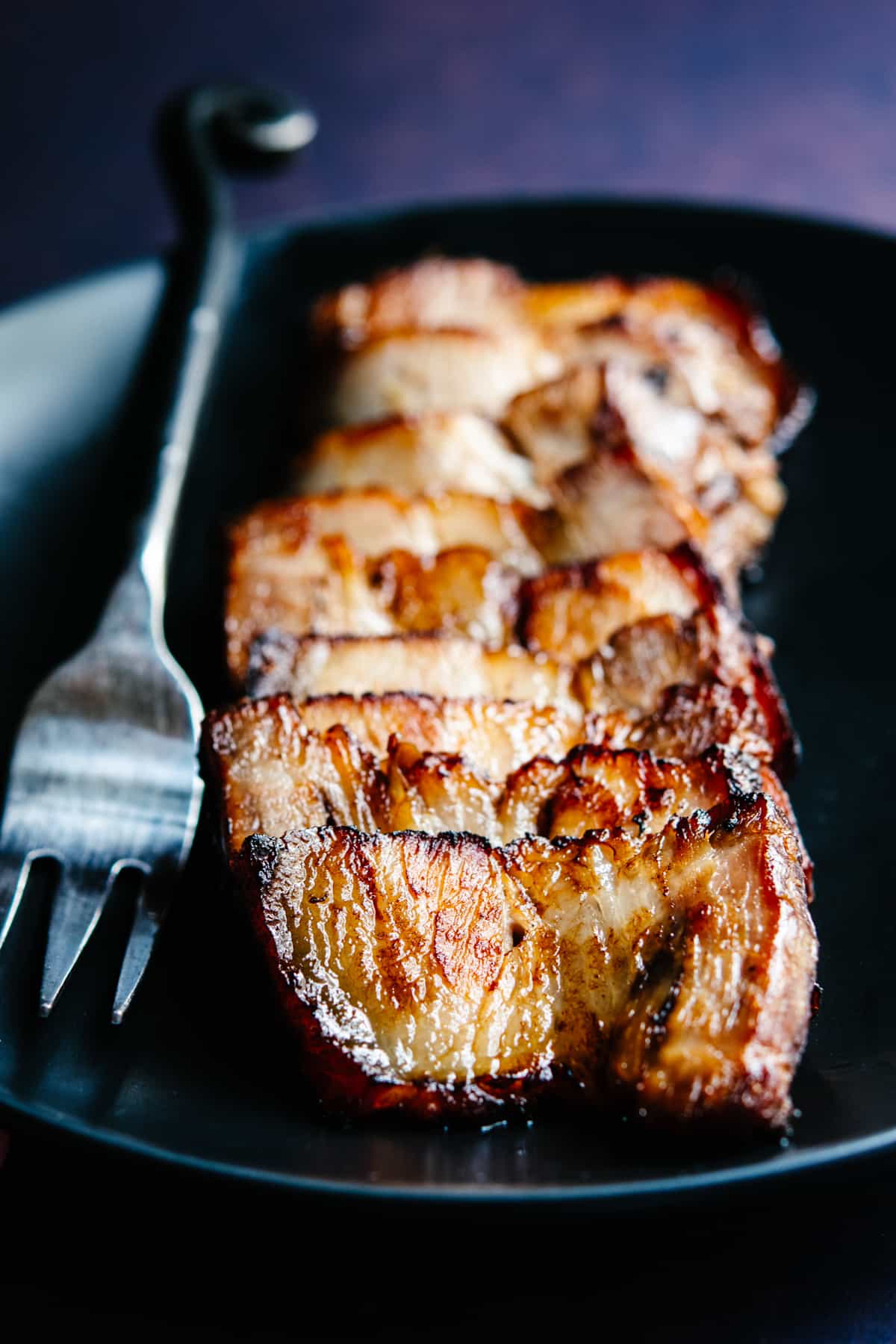
I love making this Chashu Pork at home because it has all the flavor of my favorite ramen shop, but in less time and without the cumbersome step of rolling the pork belly.
This post may contain affiliate links. Please read our disclosure policy.
Chashu Pork is meltingly tender pork belly that’s been slow-braised in an intense blend of soy sauce, sweet mirin, ginger, garlic and green onions. It’s an essential topping at any ramen house and, with this much simplified method, it’s easy to make at home.
When you’ve seen other chashu pork recipes, the meat may have been tightly rolled with twine into a spiral. Though very pretty, it requires large cuts of pork belly (2 pounds or more) and a bit of time and skill to roll and tie it properly. Here I’m using a smaller cut (just 1 pound) with a shorter cooking time and no rolling required, all of the flavor and none of the fuss.
“I very rarely leave comments or ratings on recipes but this one came out so unbelievably well that I had to come back! I’ve never had luck cooking pork belly on my own as it would often turn out tough and chewy and not at all like what you’d get at the local ramen place, but this one was absolutely exceptional, even though I didn’t have enough mirin (I subbed equal parts white wine and water to make up for the difference lol). The pork belly turned into the melt-in-your-mouth stuff of dreams. I used it in a chashu-don and I genuinely think it’s the best thing I’ve ever made. Thank you!!!
shane
Table of Contents
Recipe at a Glance
- Prep Time: 10 minutes
- Total Time: 10 hours 50 minutes
- Yield: 6 servings
- Skill Level: Easy
Ingredients for Chashu Pork
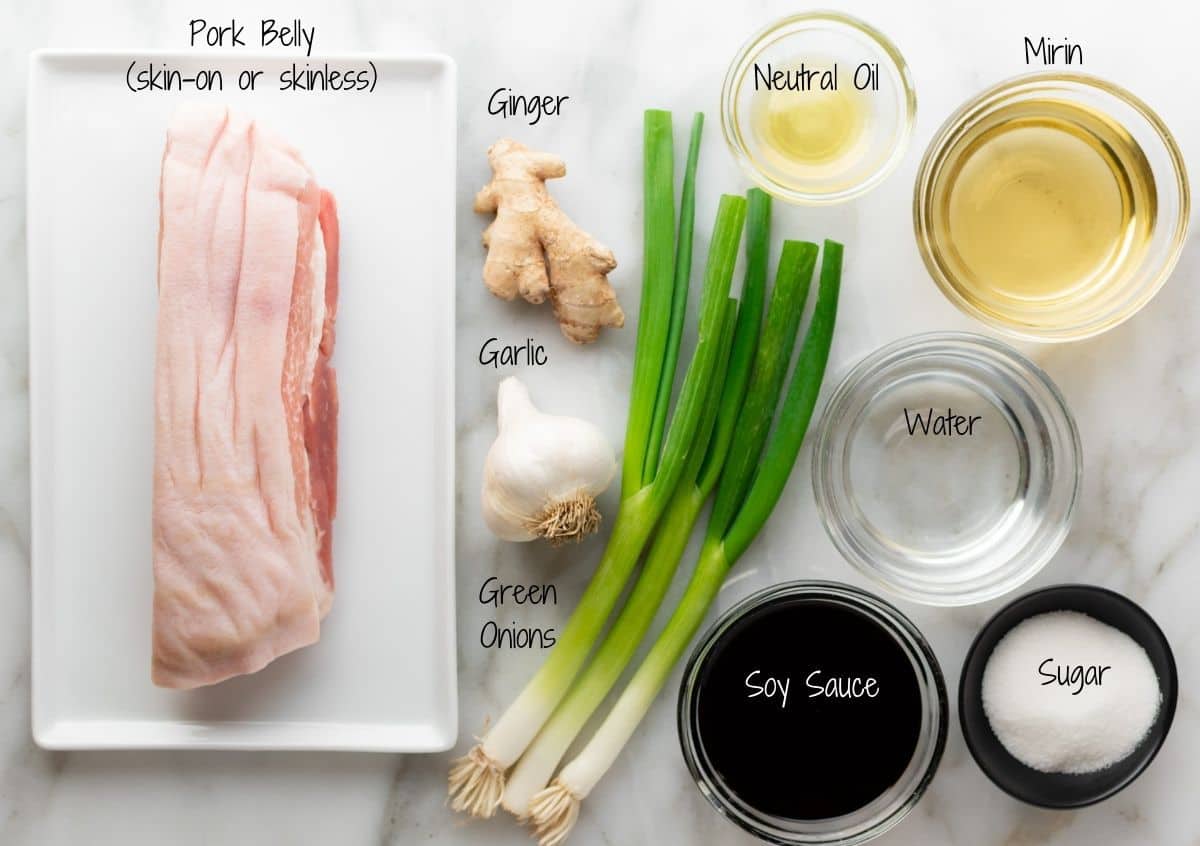
- Pork Belly: Skin-on or skinless, but you want a thick cut with even thickness. Thin cuts cook too quickly and won’t have the same melt-in-your-mouth quality.
- Soy Sauce: I typically use regular soy sauce, but tamari is a great gluten-free option.
- Mirin: You can swap in sake, but you’ll want to add an extra tablespoon of sugar to balance the flavor.
- Sugar: Standard granulated white sugar works best here.
- Oil: A neutral, high-heat oil like avocado oil is ideal. Avoid anything with a strong flavor that might compete with the sauce.
- Garlic: Fresh garlic makes all the difference. Look for plump heads with smooth skin and firm cloves.
- Green Onions: Spring onions work too when they’re in season—they add the same mild, slightly sweet flavor.
- Ginger: Fresh ginger is a must. Powdered ginger just doesn’t bring the same warmth and depth.
Chashu and Tonkotsu Ramen
If you’ve ever had Tonkotsu ramen (meaning “pork bones”) before, with its rich, creamy pork bone broth, you already know chashu pork, the tender slices of pork belly served on top. It’s traditionally made by rolling the meat into a log and braising it ‘low and slow’ for many hours, then chilling overnight. The next day it’s thinly sliced and warmed before serving.
What is chashu?
The name chashu comes from the Cantonese dish “char-siu,” meaning “fork roasted.” Though the names and some of the flavors are similar, the dishes are prepared differently. Cantonese char-siu is roasted after marinating in a sweet sauce with five spice powder and often red food dye. By contrast, Japanese chashu, is braised low and slow in a sweet and salty mixture, often with aromatics like ginger and garlic, but without five spice powder or food dye.

How to Make Chashu Pork
Step 1: Combine braising liquid ingredients: water, soy sauce, mirin and sugar; stir until sugar dissolves.

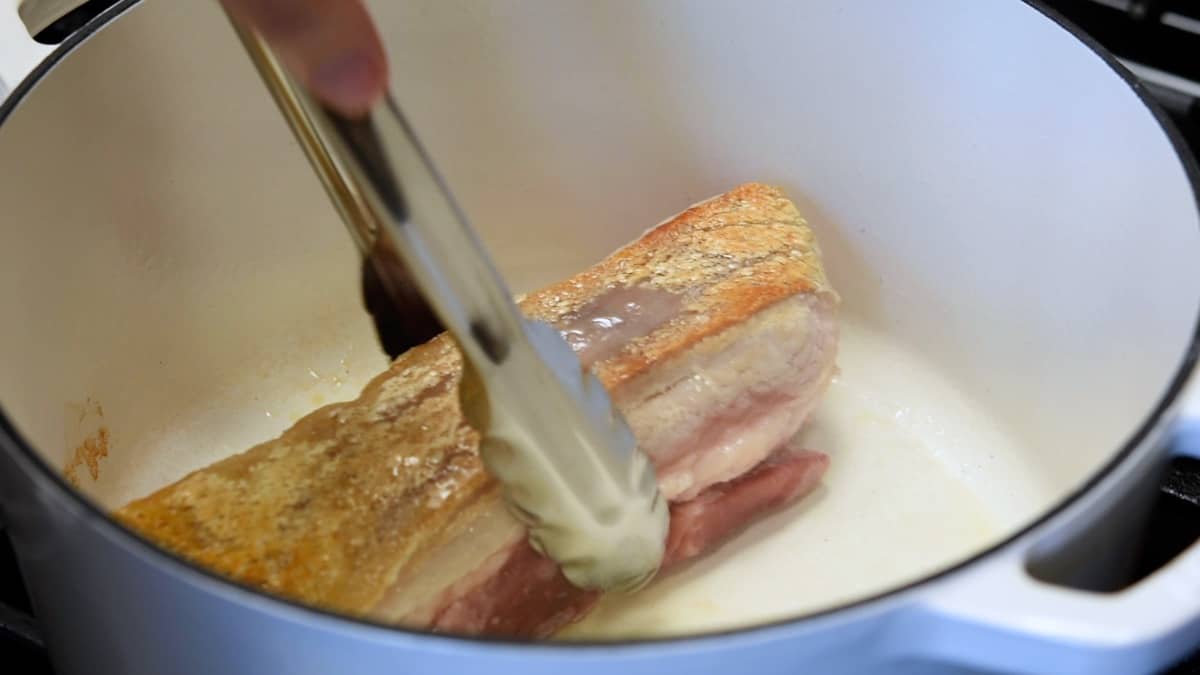
Step 2: Sear pork belly on all sides in hot oil in an oven safe pot. Remove from heat; add aromatics (ginger, garlic and green onions) and pour braising liquid over. Cover tightly with lid and cook, fat / skin-side down in an oven preheated to 250˚F for 1 1/2 hours. Flip meat and cook 1 hour more.


Step 3: Transfer meat to a smaller container and pour braising liquid over. Once it cools, cover and refrigerate overnight. The next day, transfer the meat to a cutting board and thinly slice. Pan fry over medium heat until lightly golden and serve as desired.


Not Just for Ramen
Don’t limit the use of your chashu to just soup. Though this unctuous, melt-in-your-mouth meat is the ideal topping for Pork Belly Ramen, weeknight easy Homemade Ramen or with Miso Ramen Broth or Shoyu Ramen Broth (with Homemade Ramen Noodles!). It’s also wonderful served over udon, soba, or rice noodles, layered over rice (chashu don) with braised vegetables and Soy Sauce Eggs, enjoyed on its own like Korean Pork Belly, or as a chashu pork sandwiches on brioche slider buns. i.e., Pork Belly Sliders.
And once your chashu has chilled overnight, don’t toss the braising liquid! Skim off the fat and save it to add deep, savory flavor to soups, steamed vegetables, noodle and stir-fry dishes, or rice bowls. It freezes well too if you don’t need it right away.
Pork Belly: Skinless vs. Skin-On
Either cut works well, but skinless pork belly will render more fat as it braises, leaving you with leaner slices. With skin-on pork belly, the meat may curl as it braises (as in this Braised Pork Belly recipe). If that happens, cook it 30 minutes per side during the final hour instead of flipping it completely.
Storage Tips
Enjoy your chashu pork within 3 or 4 days or freeze for up to 3 months.

Video
Equipment
- Dutch oven or other heavy, oven-safe pot
Ingredients
- 1/2 cup water
- 1/2 cup soy sauce
- 1/2 cup mirin
- 2 tablespoons granulated sugar
- 2 teaspoons vegetable oil such as avocado oil or other high heat, neutral flavored oil
- 1 pound pork belly skin-on or skinless (see recipe note #1)
- 2 large garlic cloves crushed and peeled
- 3 green onions cut lengthwise into 2-inch pieces
- 2 inches fresh ginger root thinly sliced (peeled if desired)
Instructions
- Preheat oven to 250˚F.
- In a medium bowl, whisk together water, soy sauce, mirin and sugar until sugar dissolves. Set aside.
- Heat oil over medium-high heat in a Dutch oven or other heavy, oven-safe pot until shimmering, but not quite smoking. Add pork belly and sear on all sides, about 2 minutes per side. Remove from heat.
- Flip pork belly if needed so that the fat / skin side is down. Pour soy sauce mixture over (the liquid should come about half way up the side – add a bit more water if it doesn't) and add garlic, green onions and ginger to liquid. Cover pot and place in the center of preheated oven. Cook for 1 1/2 hours; then flip pork belly to meat side and cook 1 hour more (see recipe note #2). Let pork belly cool in liquid, then transfer to a smaller container, pouring cooking liquid over the top; cover and refrigerate overnight.
- The next day, scrape the fat off of the braising liquid and transfer pork to a cutting board. Strain solids from braising liquid and save for another use. (recipe note #3) With a sharp knife, cut into thin slices and pan fry until lightly golden in a non-stick skillet over medium heat. Serve as desired. (recipe note #4)
Notes
- Use this recipe for skin-on or skinless pork belly. The main difference you’ll notice is how much more fat renders from the skinless cut. Look for a thick cut of pork belly with even thickness. Very thin cuts will cook faster and you’ll need to reduce the overall cook time. I recommend checking it every 15 minutes or so once you’ve flipped your pork belly.
- With skin-on pork belly, the belly may curl somewhat so that it doesn’t lie flat when you flip it. If this happens, cook skin side down for 1 1/2 hours, then, instead of flipping completely, cook on each side for 30 minutes each. Skinless pork belly is less likely to curl and you can just flip it completely, following the recipe instructions. Either way, you’ll need 2 1/2 hours total cook time unless your pork belly is thin (see recipe note above).
- Use the braising liquid to drizzle over any kind of meat or seafood, to flavor stir-fries or ramen broths.
- I recommend enjoying it in my Pork Belly Ramen with Homemade Ramen Noodles!
Nutrition
Nutrition information is automatically calculated, so should only be used as an approximation.



What should we add to the pan when cooking the cut pork?
Hi Marvin! If you’re using a non-stick pan or cast iron skillet, there is likely enough fat in the slices that you won’t need more. But you can always add a little of the leftover cooking fat or even a slick of neutrally flavored cooking oil (I typically have avocado oil on hand). I hope that helps!
I very rarely leave comments or ratings on recipes but this one came out so unbelievably well that I had to come back! I’ve never had luck cooking pork belly on my own as it would often turn out tough and chewy and not at all like what you’d get at the local ramen place, but this one was absolutely exceptional, even though I didn’t have enough mirin (I subbed equal parts white wine and water to make up for the difference lol). The pork belly turned into the melt-in-your-mouth stuff of dreams. I used it in a chashu-don and I genuinely think it’s the best thing I’ve ever made. Thank you!!!
This is wonderful to hear, Shane! I’m so glad you’re enjoying the recipe! I made it this week too – my husband and I have been enjoying it in a vegetable and noodle stir-fry the past few days and we feel exactly the same way. It literally melts in your mouth.
I would love to try this but my oven does not go lower than 300, and ideas on time differences for this conundrum?
Hi Michael! I haven’t tested this recipe at 300, so I can’t say for sure. My guess is that it will work, but you’ll definitely need to shorten the cooking time. I’m sorry I don’t have a more specific answer.
I am not very experienced in cooking pork, so my question is basic: where can I buy a pork belly? I don’t recall seeing it in the regular grocery stores. (I live in WI). Thanks for your help.
My granddaughter is the adventurist and ramen lover, so I want to make this for her!
Hi Patricia! I love that you plan to make this for your granddaughter. Pork belly is the cut that’s used for standard bacon, just not cured, smoked or cut. It’s sole with and without the skin on (either will work for this recipe – see the post and recipe notes). Your local grocery store meat counter is likely to have it or be able to get it for you and a butcher would almost certainly have it. I hope that helps!
Any advice on how to cook this in a slow cooker? My slow cooker has a sear function so I can sear in the pot before slow cooking, but I can only set it on high or lo. Any ideas on which heat setting or for how long?
Hi Leah! That’s a great question. I have not made this in a slow cooker, but I don’t see why not. It’s nice that you can sear right in your slow cooker. From what I understand, low on most slow cookers is about 200˚F, a bit lower than the 250˚F that the recipe calls for. Once you sear the pork belly and add the other ingredients, I’d cook it on low – my best guess is to add 30 minutes to an hour to the overall cook time. I hope that helps!
Can I make this without refrigerating it afterward? Just sear it once it’s done slow cooking?
Hi Danny! When the chashu pork is freshly cooked it’s meltingly tender and so soft it would be difficult to slice. Refrigerating it overnight in the cooking liquid further infuses it with flavor and makes it easy to slice while retaining the tenderness.
Ok trying this today. When I went to the butcher there was bone in pork belly with more meat and there was regular pork belly that was thinner (both skin on). I bought the regular and will keep a close eye.
Marissa, My oven is broken but I want to start making this tonight, as the weather has started to turn chilly in Atlanta…perfect for a bowl of ramen!! My 15 year-old son and I are ramen junkies!! Can I prepare the pork belly in a slow cooker? If so, for how long and at what setting (high or low) would you recommend?
Hi Dawn! I haven’t tested this recipe in the slow cooker so I can’t say for sure, but I don’t see why not. I recommend doing the first half of step 4 on the stove top – searing the meat and adding the aromatics and liquids so everything is hot when you add it to the slow cooker. Then my best guess is 2 to 3 hours on high or 4 to 5 hours on low (depending on your slow cooker and the thickness of your pork belly), flipping the meat half way through the cooking time. But without testing it myself, I’m really not sure about the cooking times, so please keep a close eye on it for overcooking and if it doesn’t seem done, don’t be afraid to extend the cooking time. I hope that helps!
So…I just posted a rating on your ramen noodles. And am now realizing that we used another recipe of yours for the same meal! We made this chashu pork to put in the ramen soup (with the homemade noodles) and it was spectacular
I’m so glad that you enjoyed this, Mary! Thank you for coming back to let me know.
Ooo this Chashu Pork looks and sounds phenomenal – so tender, melt-in-your-mouth, crispy outside, and I bet aromatic! I’ve only cooked with pork belly a few times in the past, but this recipe inspired me to experiment with it much often!
Thanks, Ben! I hope you’ll try it!
OMG, I’m drooling!!!! I used to eat pork belly (kakuni) more than I’d like to admit (ahh-hem, daily) ages ago when I worked in a Japanese restaurant. And, seeing this Chashu is reminding me that it’s been waaaaaayyy too long since I’ve gotten my pork belly fix! Your Chashu pork looks absolutely AMAZING and your video has me literally drooling all over my keyboard!!! Bookmarking this to make PRONTO!!! Yummy yummy!
aww…thank you, Cheyanne!
That braising liquid sounds like it’s right up my alley – it’s intense in flavor, but it sounds delicious. I don’t have much experience cooking with pork belly, but I think it’s time I conquer that fear! I’m going to be dreaming about this chashu pork all day now!
Conquer that fear, David! haha…I promise it’s super easy and the braising liquid is so versatile!
Marissa, this looks absolutely amazing. The photographs are mouth-watering and stunning — I would hang them on the wall! This is such a dreamy blend of ingredients — and soaking into that pork, oh my! 🙂 ~Valentina
You’re so kind, Valentina! Thank you!!
My son Sean and I reallly enjoy pork belly Marissa! I can’t wait for us to make this together. I know we’d love it!
I’d love for you and your son to try this one, Mary Ann! I hope you’ll both love it.
I am not a ramen fan, but I do LOVE both char-siu and chashu. Yours looks authentic and really really yummy. An excellent recipe, Marissa.
Thank you, Angie!